

Sea Eagles on the Isle of Wight
The re-introduction of Sea Eagles to the Isle of Wight

Image credit Ainsley Bennett Photography
During the summer of 2019 the Roy Dennis Wildlife Foundation and Forestry England released six juvenile white-tailed eagles on the Isle of Wight.
The first year in a five year reintroduction programme, that aims to return this once widespread and iconic species to southern England – lost from our landscape due to persecution and human activity. The project has a licence from Natural England to release up to 60 birds during the five year project.
No natural predators
White-tailed eagles are an apex predator, meaning they sit right at the top of the food chain and have no natural predators. Their populations are controlled through competition with other white-tailed eagles and as a result the live in very low densities in the landscape. White-tailed eagles are generalist predators, but in the nearby Netherlands, where the natural environment is similar to southern England – they preferentially take fish and waterbirds. Juvenile eagles rely largely on carrion in their first year and become more accomplished hunters as they reach maturity at five years old. At this stage they will seek a mate and set up a breeding territory within 50 km of their original nest or in this case the release site. The pair will defend their territory from other eagles and can live for 20 years or more, laying up to three eggs per year but usually only successfully rearing one or two chicks.
How do I know if I’ve seen one?
White-tailed eagles are huge! But a sense of scale can be difficult from afar or without anything to compare it to. White-tailed eagles have a 2.5m wingspan, their wings are both long and broad, and they have long obvious primary feathers – that look rather like fingers. Their head protrudes from their body in flight and the bill looks long and heavy. If you’re lucky enough to see one perched in a tree, even from a distance the head and bill standout. White-tailed eagles have a distinct plumage once they reach maturity, their bright white tail sticks out even on a dull day and the bulk of their plumage is a grey brown with highlights across its head and upperpart. Juvenile birds are somewhat less colourful; being a darker brown, the flight feathers appearing darker still, the underside has some white flecks on the body and wings.
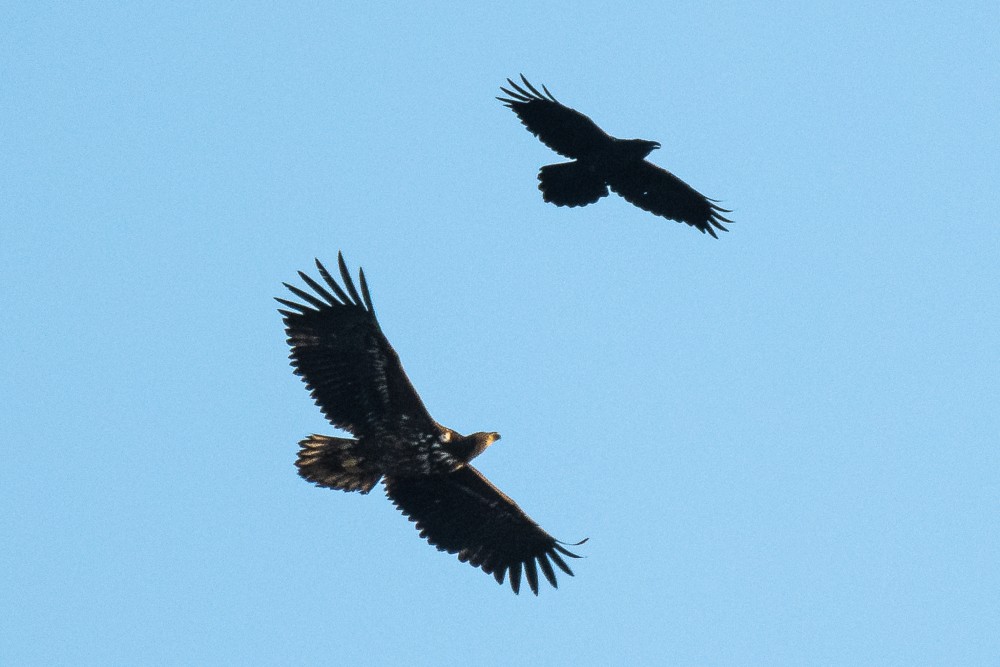
Image credit Ainsley Bennett Photography
Where can I see one?
After the birds are released, they are wild birds – they go where they will, albeit we can follow their progress using satellite tags. The best chance of seeing a white-tailed eagle in the wild is to head to some high ground on a sunny day and scan the skies. Some clues to an eagle being nearby might be a big flock of aggravated crows and jackdaws, or buzzards calling and diving at a particular tree. They can be remarkably unobtrusive, sitting in a tree for hours on end out of view, patience and luck are certainly needed to spot white-tailed eagles.
Join the walk ‘A hike through eagle country’ on the 6th May to get a feel for the land that these magnificent birds inhabit. Led by Steve Egerton-Read from Forestry England. Sightings are highly unlikely, but you never know!
What do I do if I see one?
Buy a lottery ticket! You have been very fortunate, but remember to respect the eagle and the countryside code. If an eagle is looking alert or directly at you, try not to approach any closer as you may scare it away it from a nearby meal or force it to look for a new night roost – try to watch the bird from further away or move on, keeping a distance if you can.
The latest Sea Eagles on the Isle of Wight news
You can see the latest photographs and catch up with news from the project via Twitter and Instagram via @seaeagleengland, #seaeagleengland or #RoyDennisWF. We are really keen to hear from anyone who has seen the birds and can share their photographs. We do ask please that anyone posting photographs of the birds avoid revealing the location they were taken in on social media. This will help to ensure both landowners and the birds are undisturbed.