

Professor Arnold Taylor. 16th September1943 – 17th May 2025
On behalf of Visit Isle of Wight and the Walking Festival we are sad to hear of Arnolds passing. Arnold had been a keen supporter of the Walking Festival for many years. Our thoughts are with his family, friends, and the walking community on the island.
Arnold was born in Birmingham in the middle of world War II; he was one of a family of three children. Right from an early age he developed a love of science and excelled at physics and maths. He went on to study physics at Manchester University before getting his first job is science researching algae blooms in Lake Windermere. In 1975, Arnold took a job in the West Country researching plankton in the North Sea. During his thirty-year academic career, Arnold published fifty research papers in the field of Marine Physics and became a professor at Plymouth University. Life in Devon suited Arnold as he loved to take his family on countryside walks whenever time allowed.
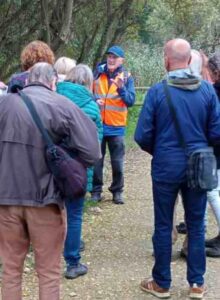
After retirement, Arnold and his wife moved to the Isle of Wight in 2004 to be near their children and soon discovered and joined the recently formed Robert Hooke Society that had been established in Freshwater. It was not surprising that Arnold had an affinity for Hooke as many of the subjects that interested this amazing 17th century scientist, interested Arnold as well. This included maths, astronomy, geology, palaeontology and meteorology. Arnold, along with a small number of other members of the Robert Hooke Society, established the Hooke Trail. The Trail is an eight-mile scenic circular walk around locations in West Wight associated with the life of Robert Hook and encompassing other sites of historical interest. Arnold was part of a small team that designed the plaques located at various spots along the Hooke Trail. Each plaque informs the reader of one aspect of Hooke’s Scientific career or a key moments in history. Arnold also wrote a concise booklet available to those walking the trail that contains many interesting details. Arnold delighted in leading groups of people visiting the Island for the walking festival around part of the trail and imparting his detailed knowledge about Hooke as well as other aspects of local historical interest. The visitors not only had the pleasure of walking part of our beautiful island but benefited from Arnold’s enthusiasm and knowledge.
I recall an occasion when Arnold had collected a replica of an air pump and chamber made by Hooke with which Boyle and Hooke conducted ground-breaking experiments. The replica had been made for the Hooke Exhibition. He was stopped by two curious women who asked what this strange looking item
of seventeenth century scientific equipment was as they had never seen anything like it before. Arnold gave an impromptu lecture explaining how it was the hadron collider of its day, the discoveries it made possible and outlined many of Hooke’s other achievements. Arnold was in his element whenever he was promoting a better awareness of a great man that he admired and of whom most had not heard but deserved a greater recognition.
Arnold was promoting Hooke’s reputation to the end. He gave a presentation to a visiting party from The Royal Society of Chemists and the Royal Microscopic Society just a few days before his unexpected death. Not only will he be missed by the Robert Hooke Society for his knowledge, his counsel, his friendship and his determination to get things done, his passing will leave a hole in the heart of everyone that knew him. He is survived by his wife, Venetia, and his two children Kate and Stephen.